

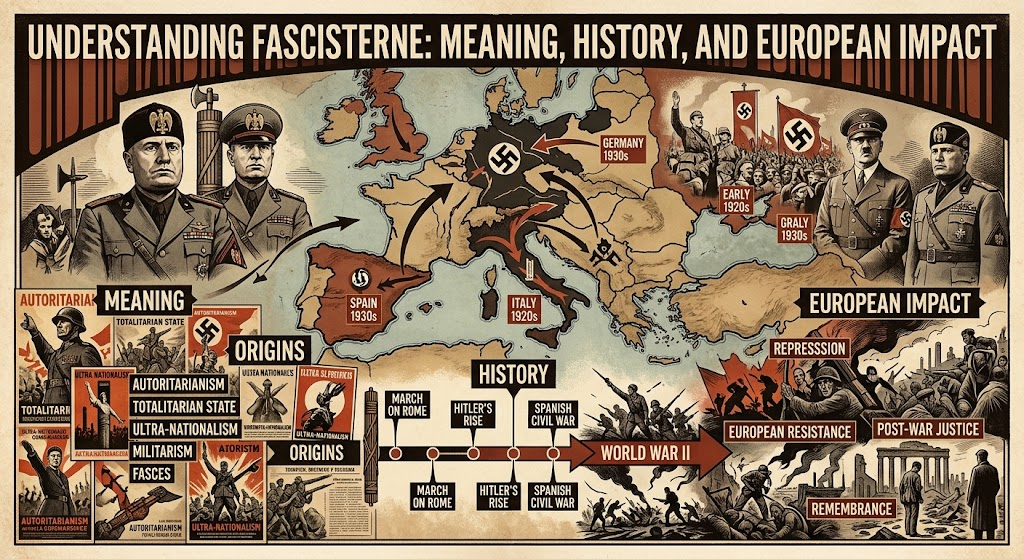
The term fascisterne often pops up when people read about 20th-century history. It sounds mysterious to non-Danish speakers, but it carries a very specific, simple meaning. When you break down the word, fascisterne is simply the Danish term for “the fascists”. It describes the actual people or groups who followed far-right authoritarian movements, rather than describing the underlying theory itself.
Understanding fascisterne helps us unlock how major political events unfolded across Europe after World War I. Many nations faced high inflation, political division, and social confusion during those years. When traditional institutions struggled to fix these problems, radical groups stepped in with big promises of unity, discipline, and national pride.
In this article, we will examine what fascisterne means, how the political movement grew, and why these historical lessons remain relevant for understanding modern democracy.
Table of Contents
What Does Fascisterne Mean in Plain Language?
To understand fascisterne, it helps to look at basic Danish grammar. In the Danish language, the word fascist refers to one single person who supports fascist ideas. The word fascister means multiple fascists. Adding the “-ne” suffix turns the word into a definite noun: fascisterne, which translates directly as “the fascists”.
This distinction matters because fascisterne focuses on individuals and groups rather than abstract political principles. When historians write about fascisterne, they are talking about real historical figures, political party members, and public supporters who organized under these banners.
The Difference Between Fascisme and Fascisterne
People often mix up fascisme and fascisterne, but they serve two distinct purposes in language. Fascisme is the political theory itself. It outlines ideas about centralized state control, strict discipline, and anti-democratic governance.
On the flip side, fascisterne refers to the actual people carrying out those ideas. Think of fascisme as the playbook, while fascisterne represents the team wearing the uniforms on the field. Keeping this difference in mind prevents confusion when diving into historical texts.
How Fascism First Developed in Europe
The roots of fascisterne trace back to Europe in the aftermath of World War I. Millions of people had suffered through the war, and the subsequent economic disruption created widespread distress. Many citizens lost faith in traditional parliamentary systems, feeling that democratic politicians moved too slowly to deliver relief.
In Italy, Benito Mussolini seized this moment of chaos. He formed political groups that promised swift action, order, and national rebirth. Over time, these groups gained real traction, proving how quickly radical political movements can grow when societies face severe instability.
The Core Characteristics of Historical Fascists
What did fascisterne actually believe and advocate for? While individual groups across different countries had unique regional traits, they shared several fundamental goals:
- Extreme Nationalism: Putting the nation above all individual rights and needs.
- Centralized Authority: Concentrating absolute decision-making power in a supreme leader.
- Rejection of Opposition: Banning political rivals and suppressing free speech.
- Mass Mobilization: Organizing public rallies, parades, and youth groups to encourage absolute group loyalty.
These beliefs altered normal public debate by discouraging open disagreement and prioritizing complete loyalty to the ruling party.
The Role of Propaganda and Visual Symbols
To win over hearts and minds, fascisterne relied heavily on aggressive propaganda campaigns. They designed catchy slogans, bold symbols, and striking uniforms that created a strong visual identity. Mass rallies were staged to make participants feel like they were part of a powerful, unstoppable wave.
By controlling newspapers, radio broadcasts, and public art, fascisterne controlled what information reached everyday citizens. They framed complex political and social problems in simple “us versus them” terms, which made radical actions seem reasonable to their supporters.
Complete Historical Overview
| Detail Category | Historical Facts & Background Information |
| Term Origin | Danish definite plural form derived from fascist. |
| English Translation | “The fascists” (refers directly to followers, not the abstract theory). |
| Key Ideology Root | Fascisme (Fascism) / Latin fasces (a bundle of wooden rods). |
| First Era of Prominence | 1919–1945 (Interwar Period through World War II). |
| Key Founding Figure | Benito Mussolini (Italy). |
| Notable Danish Counterpart | DNSAP (Danmarks Nationalsocialistiske Arbejderparti). |
| Core Beliefs | Extreme nationalism, supreme leader authority, rejection of liberal democracy. |
| Primary Methods | Mass mobilization, political intimidation, propaganda, state control. |
How Democratic Institutions Were Replaced
A major objective of fascisterne was dismantling democratic safeguards from the inside. They argued that multi-party systems caused unnecessary arguments and weakened the nation. Once in power, they systematically reduced the authority of courts, independent press outlets, and local elected boards.
Power was moved into the hands of executive leaders and appointed party officials. Without checks and balances, public accountability disappeared, leaving citizens with few legal pathways to challenge government decisions.
Fascisterne in Denmark and Northern Europe
While fascism reached its highest intensity in Southern and Central Europe, Northern Europe also experienced these political waves. In Denmark, small groups tried to organize along similar lines during the 1930s. The primary local group was the Danmarks Nationalsocialistiske Arbejderparti (DNSAP), led by Frits Clausen.
However, fascisterne struggled to gain widespread voter support in Denmark. Danish voters largely remained loyal to established democratic parties. Even during the German occupation in World War II, local fascist groups received minimal electoral support, showing the strength of democratic institutions in the region.
The Fall and World War II Aftermath
The aggressive foreign policies and internal repression driven by fascisterne ultimately brought Europe into World War II. The war resulted in widespread destruction, massive loss of human life, and severe economic devastation across the continent.
By 1945, Allied military victories brought down the major fascist regimes in Europe. The aftermath led to the prosecution of key leaders and a major international effort to rebuild democratic governments, establish human rights standards, and protect civil liberties worldwide.
Modern Lessons from Studying Historical Fascism
Why do historians, teachers, and political analysts continue to study fascisterne today? Examining these historical events helps us recognize early warning signs of political extremism and erosion of civil liberties.
History shows that when people feel ignored, financially stressed, or fearful of the future, authoritarian leaders may try to exploit those worries. Studying fascisterne offers valuable lessons on why protecting free speech, free elections, and open public debate is essential for maintaining healthy societies.
Conclusion: Protecting Democratic Values
Understanding fascisterne is about more than just translating a Danish word; it is about grasping a critical chapter in European history. By looking closely at how small political groups grew into powerful regimes, we see the importance of protecting democratic processes. Freedom, fairness, and open public discussion require constant attention and care.
Frequently Asked Questions (FAQs)
Q1: What does fascisterne mean in English?
It is a Danish word that translates directly to “the fascists”. It refers to specific groups of people who supported fascist movements.
Q2: Is fascisterne the name of an ideology or a party?
No. It is simply a plural noun describing individuals. The word for the political ideology in Danish is fascisme.
Q3: Where did the root word “fascist” come from?
It comes from the Latin word fasces, which described a bundle of wooden rods tied around an axe. In ancient Rome, this symbol represented unity, civic authority, and power.
Q4: Did Danish fascists ever hold major power in Denmark?
No. While groups like the DNSAP existed in Denmark during the 1930s and 1940s, they received very low voter turnout and never gained mainstream political control.
Q5: Why is propaganda so closely associated with fascisterne?
Historical fascists relied on propaganda, speeches, and public rallies to control public opinion and build strong group loyalty.
Q6: Why do people still research fascisterne today?
Scholars study fascisterne to learn how democratic institutions can break down during times of crisis and how societies can better protect human rights and civil liberties.
