

The relationship between former U.S. President Donald Trump and Ukraine has played a defining role in international politics over the past several years. From the origins of the Russia-Ukraine war in 2022 to shifting U.S. foreign policy under Trump’s leadership, the topic of Trump Ukraine remains complex and widely discussed. This article explores how Trump’s approach to Ukraine has evolved, the diplomatic and political controversies that have unfolded, and the broader implications for international security and U.S. foreign policy.
At the center of this discussion are shifting alliances, controversial negotiations, and debates over military aid. Trump’s stance on Ukraine has influenced global diplomacy, strained transatlantic relations, and raised questions about the future of support for the Ukrainian government in its resistance against Russia.
Historical Background: Trump Ukraine Ties Before the 2020s
The Trump Ukraine narrative did not begin with the 2022 invasion of Ukraine by Russia. A highly publicized episode in 2019–2020 involved U.S. political controversy when then-President Trump was impeached by the House of Representatives for allegedly withholding military aid to Ukraine to pressure its government to investigate political rival Joe Biden and his son. Trump was accused of leveraging U.S. support to extract a political favor from Ukrainian leadership, a charge that dominated U.S. politics at the time. The Senate acquitted him in early 2020, but the episode left a lasting imprint on U.S.–Ukraine relations and American domestic politics.
While that earlier incident shaped public perception, the Trump Ukraine relationship entered a new and more consequential phase following Russia’s full-scale attack on Ukraine in February 2022.
Early Days of the Russia-Ukraine War and U.S. Policy
When Russia launched its invasion of Ukraine in 2022, the United States, under then-President Joe Biden, became one of Ukraine’s staunchest supporters, sending billions of dollars in military and humanitarian aid to assist Kyiv’s defense against Russian forces. However, when Trump returned to office in 2025, his approach to the Ukraine conflict shifted significantly, altering the course of U.S. policy and reshaping international expectations.
Trump campaigned on a promise to end the war rapidly. He framed the conflict as an open-ended military involvement in Europe that the United States could not afford indefinitely. Unlike some of his predecessors, Trump questioned the wisdom of prolonged American support without a negotiated settlement.
Trump Ukraine Military Aid: Controversial Suspension
One of the most significant developments in the Trump Ukraine narrative was his decision to pause U.S. military aid to Ukraine after a highly publicized confrontation with Ukrainian President Volodymyr Zelenskyy. Following a contentious encounter in the Oval Office in February 2025, Trump issued an order to halt and review key portions of military assistance, which had been a cornerstone of Ukraine’s defense posture.
White House officials indicated that aid was paused to ensure it would contribute meaningfully to peace negotiations with Russia, a framing that Trump and his allies presented as necessary pressure to bring all parties to the negotiating table. Critics, however, warned that withholding military support could weaken Ukraine’s ability to defend itself against a powerful adversary.
Trump’s posture was a marked departure from the bipartisan consensus in Congress, where many lawmakers—especially Democrats—have argued for sustained and substantial backing for Ukraine. His move was met with mixed reactions even within his own party, with some Republicans defending the decision while others expressed concern about the strategic consequences of a weakened Ukrainian resistance.
Diplomatic Tensions and Peace Negotiation Efforts
The Trump Ukraine approach has also been defined by efforts to press Ukraine into peace negotiations. Trump repeatedly urged Ukrainian leadership to pursue talks with Russia, arguing that a swift diplomatic settlement may end the conflict sooner rather than later. He publicly stated that Ukraine’s President Zelenskyy could potentially end the war “almost immediately” if certain conditions were met.
Such statements, however, generated skepticism among European leaders and Ukrainian officials who maintain that ceding significant territory or compromising on core sovereignty issues would set a dangerous precedent and could undermine Ukraine’s long-term stability and democratic institutions.
At international forums, including the Munich Security Conference, discussions about Ukraine’s security guarantees underscored ongoing divisions. While Ukrainian leaders have demanded firm security assurances—arguing that peace must be built on commitments to defend Ukraine’s borders—Trump’s emphasis on negotiations often appeared to focus more on ending hostilities quickly than on specific boundary conditions or guarantees.
Trump Ukraine and U.S.–European Relations
The fallout of Trump’s Ukraine policy reverberated beyond Kyiv and Washington, affecting relations with key European allies. European leaders—including those from Germany and France—have called for sustained support for Ukraine and have sometimes criticized the Trump administration’s rhetoric, which they view as inconsistent or unpredictable.
At forums such as the Munich Security Conference, U.S. officials under Trump emphasized the importance of shared values and transatlantic cooperation, yet European leaders also intensified efforts to assert more autonomous defense capabilities, signaling that reliance on the United States could shift amid fluctuating American foreign policy. This tension was particularly visible in discussions about long-term security guarantees for Ukraine and broader responses to Russian aggression.
Domestic Political Impact: Trump Ukraine in U.S. Politics
The Trump Ukraine theme has arguably become a recurring flashpoint in American domestic politics. Supporters of Trump view his handling of the Ukraine conflict as pragmatic, focused on securing peace and ending costly foreign entanglements. They praise his willingness to challenge conventional foreign policy orthodoxies and to demand concrete outcomes in exchange for American support.
Opponents, however, contend that Trump’s Ukraine policies undermine global democratic norms by emboldening Russia and weakening Ukraine’s defense. Critics argue that diminished U.S. support could embolden authoritarian regimes and erode the credibility of American alliances.
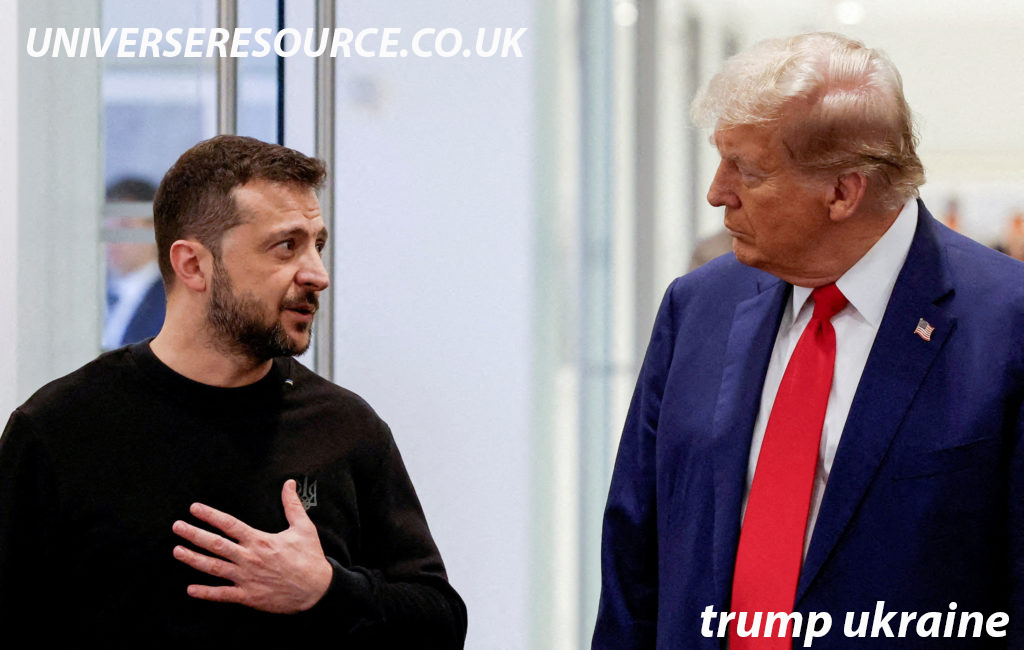
The debate over Ukraine in U.S. politics also connects to larger discussions about access to American resources, security priorities, and the role of the United States in shaping the post-Cold War global order. Images of heated exchanges between Trump and Zelenskyy—broadcast on international television—fueled polarized interpretations of both leaders’ motivations and objectives.
Humanitarian and Strategic Considerations
The Trump Ukraine dimension extends beyond political and military aid debates to encompass humanitarian issues. The war has displaced millions of civilians, destroyed infrastructure, and created urgent needs for food, shelter, and medical care across Ukraine.
Trump’s critics argue that by threatening to cut off support or by shifting aid priorities, the U.S. under his leadership has risked exacerbating human suffering. They contend that strategic backing for Ukraine’s defense is connected not only to regional security but also to humanitarian outcomes that affect millions of noncombatants.
At the same time, Trump’s defenders suggest that pushing for negotiations and de-escalation might save lives by bringing an earlier end to active hostilities. This framing positions the Trump Ukraine policy as a pursuit of peace that prioritizes diplomacy and negotiation over perpetual war.
The Global Strategic Stakes
The Trump Ukraine story cannot be separated from broader global strategic dynamics. For decades, U.S. foreign policy has hinged on upholding collective security arrangements, supporting allies, and deterring aggression. The war in Ukraine, triggered by Russia’s invasion, tested these paradigms and forced key allies to reassess their defense postures.
Trump’s emphasis on negotiations, paired with conditional support for military aid, reflected a strategic vision that sometimes diverged from that of European allies and NATO partners. Critics fear that a retreat from firm support for Ukraine could embolden other authoritarian actors or signal a wavering U.S. commitment to collective defense principles.
Supporters argue that a rebalancing of responsibilities—where Europe plays a more significant role in its own security—could lead to a more equitable sharing of defense burdens.
Trump Ukraine: Implications for Future Conflicts
The evolving Trump Ukraine policy carries potential implications for how the United States approaches future conflicts. If military aid and diplomatic leverage are tied more closely to negotiated peace efforts, future wars involving U.S. interests may encounter similar debates about how best to use American influence.
For policymakers around the world watching the outcome of Trump’s Ukraine strategy, lessons may be drawn about the limits of military engagement, the importance of coalition diplomacy, and the role of negotiations in ending protracted conflicts.
Some analysts argue that the Trump approach could lead to a new model of conflict resolution that prioritizes negotiated settlements—even if that means challenging allies to make difficult concessions. Others fear that such models could undermine democratic resilience and encourage aggression in states where deterrence remains essential.
Prospects for U.S.–Ukraine Relations Post-Trump
Looking forward, the Trump Ukraine narrative will likely remain a subject of intense discussion in both Washington and Kiev. As Ukraine continues its fight against Russian forces, support from the United States—whether military, economic, or diplomatic—remains a pivotal factor in shaping the conflict’s outcome.
Even as Trump’s policies have introduced uncertainty, Ukraine has sought alternative partnerships and forged stronger ties with European nations. At the same time, the question of how the United States under future administrations will engage with Ukraine remains open.
Regardless of electoral outcomes in the United States or elsewhere, the legacy of Trump’s Ukraine policies will influence diplomatic norms, alliance structures, and global approaches to conflict resolution well into the future.
Conclusion
The story of Trump Ukraine is a multifaceted and enduring chapter in recent global affairs. It encompasses controversies from U.S. domestic politics, shifting foreign policy priorities, international diplomacy, and strategic calculations about war and peace. From controversial aid decisions and personal clashes with Ukrainian leaders to broader debates about America’s role in the world, Trump’s approach to Ukraine has left an indelible mark on history.
Understanding the full impact of Trump Ukraine requires analyzing not only the political headlines but also the deeper strategic and humanitarian consequences of those policies. As the situation between Russia and Ukraine continues to evolve—and as global leaders respond to a changing geopolitical landscape—the legacy of Trump’s engagement with Ukraine will remain a subject of study, debate, and consequence for years to come.
